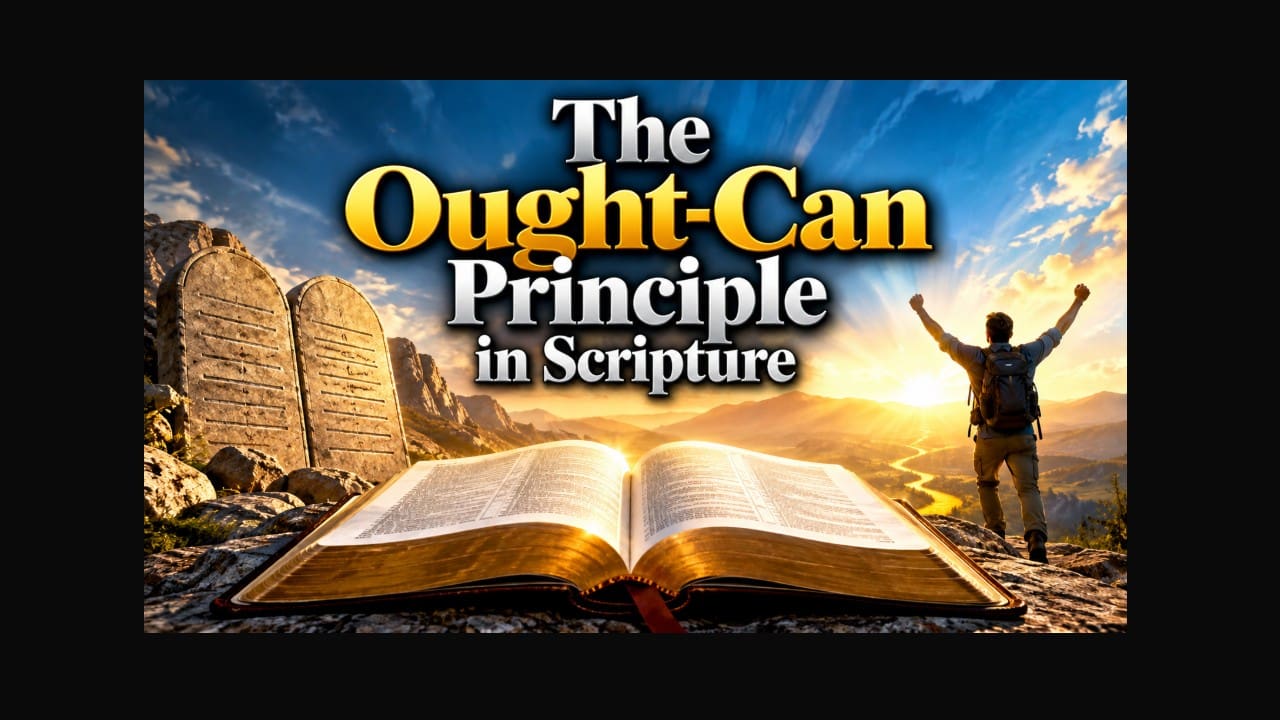
The Ought-Can Principle in Scripture
If God commands people to do something, that implies they can do it. This is known as the ought-can principle. This principle is not only intuitive, but it is also supported by Scripture.
Imagine someone commanding a blind child to read a book and then punishing the child for not doing it. What would we think of such a person? I’m sure we’d all call him a moral monster.
The Bible affirms this too. When the Egyptians required the Israelites to make bricks without providing the needed straw, the biblical writers rightly portrayed that as evil (see Exodus 5).
Both our hearts and Scripture show it’s wrong to command the impossible and then punish people for not doing it.
What about the Law?
Calvinists would inevitably push back on the ought-can principle by claiming that God commanded people to keep the Law—which was impossible to do!
Response: First, if God commanded the impossible, then he’d be guilty of doing the very thing his own book (the Bible) portrays as evil—and God cannot do evil.
Second, God said his Law was doable. In Deuteronomy 30:9-10, God said he would prosper the Israelites “if you obey the voice of the Lord your God, to keep His commandments and His statutes which are written in this Book of the Law, and if you turn to the Lord your God with all your heart and with all your soul.”
God clearly believed the Law was doable. And if this wasn’t enough proof, God went on to say in the next verse:
“11 For this commandment which I command you today is not too difficult for you, nor is it out of reach. 12 It is not in heaven, that you should say, ‘Who will go up to heaven for us to get it for us and make us hear it, that we may observe it?’ 13 Nor is it beyond the sea, that you should say, ‘Who will cross the sea for us to get it for us and make us hear it, that we may observe it?’ 14 But the word is very near you, in your mouth and in your heart, that you may observe it”
God then went on to say in that famous passage we all know well:
“19 I call heaven and earth to witness against you today, that I have set before you life and death, the blessing and the curse. So choose life in order that you may live, you and your descendants, 20 by loving the Lord your God, by obeying His voice, and by holding fast to Him” (Deut. 30:9-20).
God clearly believed his old covenant commands were doable.
The New Covenant Requirements
The apostles taught the same thing about the new covenant requirements:
“No temptation has overtaken you except what is common to mankind. And God is faithful; he will not let you be tempted beyond what you can bear. But when you are tempted, he will also provide a way out so that you can endure it” (1 Cor. 10:13).
This passage, too, unambiguously teaches that people can obey God’s commands. Nobody is decreed or determined or fated to sin, as Calvinists claim. When temptations come, God provides a way of escape, so that we can avoid sinning.
Calvinists sometimes try to get around this passage by pointing out that it was written to Christians—so it only applies to Christians.
Response: First, does this mean Christians can keep God’s commands perfectly? I’ve yet to hear a Calvinist admit even this, since it would oppose his presupposition about total depravity. Second, it’s true this passage was written to Christians, but God wants everyone to be a Christian. This is so obvious all through Scripture:
“The Lord is not willing that any should perish but that all should come to repentance” (2 Pet. 3:9).
“I take no pleasure in the death of the wicked, but that the wicked turn from his way and live” (Ezek. 33:11).
God wants everyone to be a Christian. And if someone chooses to be a Christian—by putting his faith in Christ—then God will provide a way of escape when temptations come, so that he can avoid sinning/obey God.
So 1 Corinthians 10:13 can be applicable to anyone!
The Pelagian Boogeyman
Whenever someone points out how Scripture teaches that God’s commands are doable, Calvinists will inevitably pull out the Pelagian card. “Pelagianism” is the view that man can keep God’s commands by his own power.
Response: I’m not claiming that people can obey God’s commands in their own power. What I am saying—and what the Bible clearly teaches—is that God empowers the faithful so that they can keep his commands. But it’s up to us to be faithful.
There’s a great illustration of this in Matthew 14. Jesus’ disciples were in a boat crossing the Sea of Galilee. Suddenly they saw Jesus walking on the water towards them. Jesus then commanded Peter to come to him (by walking on the water). And Peter did. As long as Peter kept his eyes on Jesus—as long as he walked by faith—he was able to do what Jesus commanded. But when he took his eyes off Jesus, he began to sink.
The lesson is that God empowers the faithful to keep God’s commands. As long as one keeps his eyes on Jesus, he can do what God commands. That’s how God designed mankind, to depend on him. This is not “Pelagianism”; this is Bible!
In fact, John straight out said:
“My little children, these things I write to you, so that you may not sin. And if anyone sins, we have an Advocate with the Father, Jesus Christ the righteous. And He Himself is the propitiation for our sins, and not for ours only but also for the whole world” (1 John 2:1-2).
This passage, too, clearly shows that we can keep God’s commands (and not sin). But IF we do sin—nobody is decreed or determined or fated to sin—but IF we do sin, then we have Jesus, who is the propitiation for not only our sins, but of the whole world. Only a twisted, perverted interpretation of this passage would deny we can live obedient lives. What we ought to do, we can do—per Scripture!
By Alex Polyak, Answering Calvinism, 9/23/26.